2026 Top Fluted Oak Panels: How to Choose? begins with a practical question: what must the wall do? Fluted Oak Panels can add warmth, rhythm, and gentle shadow to a room. However, a beautiful photograph cannot reveal density, veneer quality, edge finishing, or installation problems. The best choice depends on lighting, traffic, moisture, acoustics, and the skills available for fitting.
Start with the oak surface. Compare solid oak, oak veneer, and engineered core construction. Ask for a physical sample. Inspect the grain at arm’s length. Run a finger across the grooves. Uneven flutes may become obvious beside a window. Check the backing, panel thickness, joining system, and stated performance data. Reliable suppliers should identify material sources, cleaning guidance, and relevant fire or acoustic test results. Local building requirements still matter.
Room use changes everything. Deep flutes create stronger shadows, while narrow profiles can look calmer in compact spaces. In a busy hallway, a durable finish may matter more than a dramatic pattern. In a bedroom, texture and sound absorption may guide the decision. Do not trust marketing alone. Test the sample under daytime and evening lighting. I have seen warm oak appear strangely gray under cool LEDs. That mistake is easy to miss.
Budget for trims, adhesive, labor, waste, and future repairs. Confirm whether replacement panels will remain available. Sustainability claims also deserve careful checking, including forestry certifications and transparent product documentation. There is no perfect panel. A thoughtful choice balances appearance, evidence, maintenance, and honest limitations.
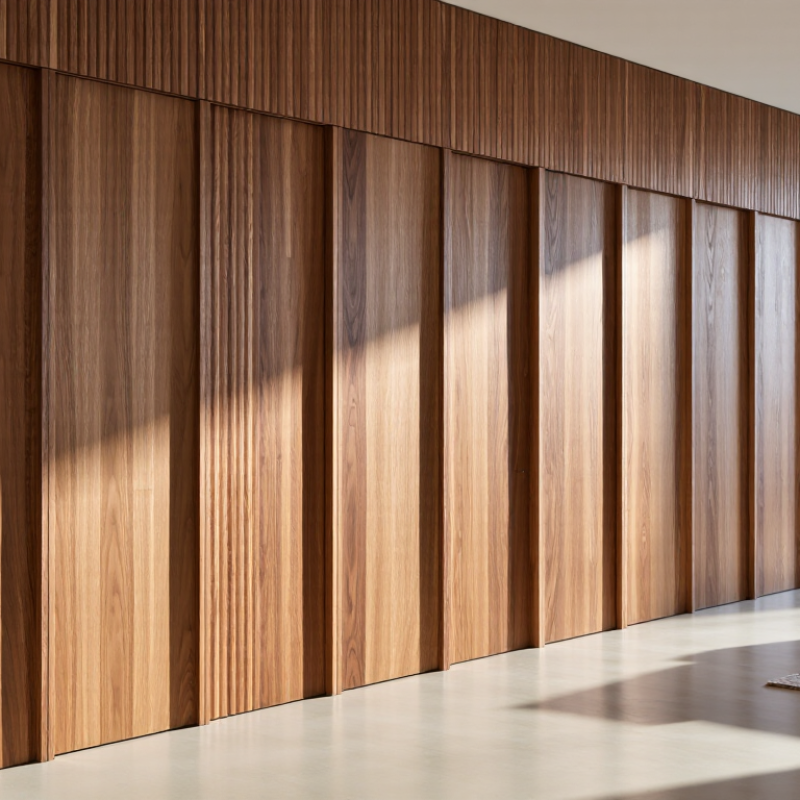
Define Fluted Oak Panels: Solid Oak, Veneer, MDF, and PVC Core Options
2026 Top Fluted Oak Panels: How to Choose?
Fluted oak panels add rhythm, shadow, and warmth to a wall. Their grooves can soften a large room, but they also collect dust. In installation work, the core matters as much as the oak face. Solid oak uses oak throughout. It feels substantial, accepts sanding, and can age beautifully. However, wide solid boards may move with humidity. Leave room for seasonal expansion.
Oak veneer uses a thin oak layer over a stable substrate. It offers real grain with less material and usually better dimensional control. Inspect the veneer direction carefully. Mismatched strips can look artificial. MDF core panels are smooth, economical, and easy to machine. They suit dry interiors, especially when the edges are sealed. Moisture remains a weakness. A small leak can swell an unprotected edge.
PVC core panels resist moisture and clean easily, making them practical near kitchens or covered bathrooms. Yet PVC can feel less natural, and its surface may show scratches under strong light. Check the panel’s fire classification, formaldehyde emissions, backing, and acoustic data before ordering. Ask for a physical sample. Screens hide color shifts. I would also test one panel against the actual wall, because warm lighting can make oak appear more yellow than expected. There is no perfect core; the honest choice depends on humidity, impact, budget, and the finish you can maintain.
Compare Flute Profiles, Panel Sizes, and Spacing for Visual Scale
Fluted oak panels should be chosen by visual scale, not appearance alone. Narrow 12–18 mm flutes create a fine, active rhythm. Wider 30–40 mm flutes feel calmer and more architectural. The eye reads repetition first.
Panel size changes that rhythm. On a 2.4-metre wall, 600 mm panels create four vertical fields, while 300 mm panels produce eight stronger divisions.
A 3–5 mm gap between panels adds shadow without making the wall feel fragmented. Keep flute spacing consistent across corners and doors. Small errors show quickly.
The Forest Resources Assessment 2020 reports that forests cover about 31% of global land area. That figure does not prove responsible sourcing. Ask for species origin, moisture control, and low-emission adhesive information. The U.S. Environmental Protection Agency notes that indoor pollutant levels can be two to five times higher than outdoors. Ventilation and certified low-emitting materials therefore matter. I would test one sample at morning and evening light. Oak can look warmer than expected. My own preference is not always reliable. A beautiful profile may still feel too busy when repeated across a full room.
Verify Material Quality: E1 Formaldehyde ≤0.124 mg/m³ Under EN 717-1
2026 Top Fluted Oak Panels: How to Choose?
When choosing fluted oak panels, verify formaldehyde performance before comparing color or groove depth. Look for E1 classification with emissions no higher than 0.124 mg/m³ under EN 717-1. This chamber test provides a clearer reference than vague claims such as “low emission” or “eco-friendly.”
Request a recent test report from the supplier. Check the tested board type, thickness, production date, and laboratory details. The result should match the panel you plan to install, not a similar-looking sample. Ask whether the oak veneer, MDF core, adhesive, and backing were tested together. They affect indoor air quality. Small details matter.
Inspect the sample in person. A strong chemical smell is a warning sign, though smell alone cannot measure emissions. Check exposed edges, grooves, and rear surfaces for poor sealing or swelling. Keep the panels dry during storage and ventilate the room after installation. I have found that rushed installation can undermine otherwise good material choices. A compliant report is important, but it is not the whole decision. Suppliers may also provide incomplete documents, and buyers should question unclear figures instead of assuming everything is safe. For bedrooms, nurseries, and compact rooms, prioritize verified testing, stable construction, and careful installation over appearance alone.
2026 Top Fluted Oak Panels: How to Choose?
Verify Material Quality: Under EN 717-1, E1 classification requires formaldehyde emissions of no more than 0.124 mg/m³, commonly referenced as approximately 0.100 ppm at 23°C. Use an independent laboratory report to confirm the actual panel result.
Evaluate Fire Safety Using EN 13501-1 Reaction-to-Fire Classifications
2026 Top Fluted Oak Panels: How to Choose?
Fire safety should guide your fluted oak panel choice, not merely its colour or groove depth. EN 13501-1 classifies construction products by reaction to fire. The rating includes flame contribution, smoke production, and burning droplets.
Classes
A1 and A2 to B, C, D, E, and F.
Smoke ratings
s1, s2, and s3.
Droplet ratings
d0, d1, and d2.
Natural oak is combustible. Many wood-based panels may achieve D-s2,d0, but the final rating depends on thickness, coating, adhesive, backing, and installation. Do not trust a showroom sample alone. Request the current classification report, test standard, product thickness, and mounting method.
A panel tested on a mineral substrate may perform differently over timber battens or an acoustic backing. This detail is often missed.
Tips:
Match the panel assembly to the real wall build-up. Check joints, ventilation gaps, and edge treatments. Ask whether the test covered vertical installation. If a supplier gives only “fire resistant,” pause and ask for EN 13501-1 evidence.
The European Commission has cited roughly 5,000 fire deaths annually across Europe, showing why material selection deserves care. NFPA’s Fire Loss in the United States During 2023 reported 3,010 civilian fire deaths and about 17.1 billion dollars in property damage. These figures do not predict panel performance, but they expose the cost of weak assumptions. A neat rating is not enough. Real installation still matters.
Choose Acoustic Panels by Tested NRC Values, Installation, and Room Use
2026 Top Fluted Oak Panels How to Choose?
Choose acoustic panels by tested NRC values, installation, and room use. A fluted oak panel looks warm, but appearance does not prove acoustic performance. Check its tested Noise Reduction Coefficient, or NRC. Under ASTM C423, NRC averages absorption at 250, 500, 1000, and 2000 Hz. A panel rated NRC 0.70 absorbs considerably more mid-frequency sound than one rated 0.30. However, NRC does not fully describe bass performance. That limitation matters in music rooms and open offices.
Testing should reference ASTM C423 or ISO 354 laboratory methods. These standards measure absorption in controlled reverberation rooms. Real rooms behave differently. Wall coverage, ceiling height, furniture, and panel spacing change results. A narrow air gap behind the slats can improve absorption, especially when mineral wool or another tested acoustic core is used. Installation quality is not a minor detail. Poorly sealed edges and limited coverage may weaken the expected result.
Tips: Match the panel to the room’s problem. Use moderate absorption for dining areas, fuller coverage for meeting rooms, and targeted ceiling treatment in offices with hard floors. Ask for the complete test report, not only a marketing rating. Confirm thickness, mounting method, frequency data, and installed coverage. I would also test a small section first. It may reveal echo, glare, or visual weight before a costly installation. Expect some compromise. No decorative panel fixes every acoustic weakness.
2026 Top Fluted Oak Panels How to Choose? - Choose Acoustic Panels by Tested NRC Values, Installation, and Room Use
| Panel Construction |
Typical Thickness |
Typical Tested NRC Range* |
Recommended Installation |
Best Room Use |
Selection Notes |
| Fluted solid oak or oak veneer without an absorptive backing |
18–25 mm |
0.10–0.20 |
Directly fixed to a solid wall |
Corridors, reception areas, decorative feature walls |
Provides limited sound absorption. Choose this option mainly for appearance and impact resistance. |
| Oak-faced slats over acoustic felt |
20–25 mm |
0.25–0.40 |
Direct wall mounting with open joints exposed |
Bedrooms, home offices, small meeting rooms |
The felt and open gaps improve mid-frequency absorption, but coverage area strongly affects the final result. |
| Oak-faced slats over acoustic felt with a 25–50 mm air cavity |
45–75 mm total |
0.45–0.70 |
Install on battens or a furring frame; keep the cavity open |
Dining rooms, classrooms, open-plan offices |
The air gap increases low-frequency absorption. Do not compress the backing material. |
| Oak-faced slats with acoustic felt and mineral wool behind |
75–125 mm total |
0.70–0.90 |
Full-height wall system with a sealed or carefully detailed frame |
Conference rooms, classrooms, music practice rooms |
A strong choice when speech clarity and reverberation control are more important than minimum depth. |
| Oak-faced acoustic ceiling clouds or suspended baffles |
40–100 mm |
0.80–1.00 |
Suspend horizontally or vertically with an air space above |
Restaurants, call centers, atriums, large open offices |
Suspended products can expose both sides and provide more effective absorption than a directly mounted panel. |
| Perforated or micro-perforated oak acoustic panel with absorber behind |
35–100 mm total |
0.55–0.90 |
Wall or ceiling installation with an absorbent backing layer |
Auditoriums, boardrooms, lecture rooms |
Perforation percentage, cavity depth, and backing density must be verified in the acoustic test report. |
| Oak acoustic panel used as a partial feature wall |
20–75 mm |
Project-dependent |
Cover approximately 30–60% of selected wall surfaces and combine with ceiling absorption |
Living rooms, hospitality spaces, executive offices |
A high NRC panel will not control room reverberation if too little surface area is installed. |
How to compare acoustic performance: NRC is a single-number rating calculated from sound absorption measurements, commonly using ASTM C423. Compare panels tested under the same mounting condition, thickness, air gap, and backing configuration.
Important: The NRC ranges above are typical planning ranges for comparable constructions, not product certifications. Request a project-specific laboratory report before final specification.
Practical rule: For speech-focused rooms, prioritize tested absorption, adequate coverage, ceiling treatment, and correct installation over oak finish alone.
Conclusion
Choosing the right Fluted Oak Panels requires more than comparing appearance and price. Start by identifying the core construction: solid oak offers natural strength and character, oak veneer provides an authentic wood surface with better material efficiency, while MDF and PVC cores may offer consistent dimensions and easier installation. Next, compare flute shapes, depths, widths, panel sizes, and spacing to ensure the design matches the room’s visual scale. Narrow, closely spaced flutes create a refined texture, while wider profiles produce a stronger architectural effect.
Material performance is equally important. Request documentation confirming that formaldehyde emissions meet the E1 limit of ≤0.124 mg/m³ under EN 717-1, and review fire performance according to EN 13501-1 reaction-to-fire classifications. For sound control, select acoustic panels based on tested NRC values rather than appearance alone. Consider the room’s purpose, wall or ceiling installation method, substrate, ventilation, and maintenance needs before making a final decision.
 Qianbang
