How to Choose the Best Fluted Wall Panels?

Time:2026-10-04 Author:Oliver
0%

Choosing the best Fluted Wall panel begins with evidence, not a showroom impression. Texture matters, but performance matters more.

Recent reports show why this category deserves careful evaluation. Grand View Research identifies growing demand for decorative wall surfaces, driven by renovation, hospitality, and commercial interiors. Mordor Intelligence also reports steady expansion in the global wall panels market, although its categories include several panel types. That limitation matters. Market figures rarely isolate fluted products.

A reliable choice connects design goals with measurable specifications. Start by checking the panel substrate, surface finish, moisture resistance, and dimensional stability. A bathroom panel needs different protection from a hotel bedroom panel. A busy corridor needs stronger impact resistance than a private study.

Acoustic claims require proof. Look for laboratory results based on ASTM C423 or ISO 354, especially when manufacturers advertise sound absorption. Fire performance should reference recognized testing, such as ASTM E84 or EN 13501-1. Do not accept “fire-safe” as a complete specification.

Sustainability also needs closer inspection. The 2023 Dodge Construction Network World Green Building Trends report shows continuing demand for healthier, lower-impact buildings. However, recycled content alone does not prove environmental value. Request an Environmental Product Declaration, material safety data, and installation guidance.

Installation is often underestimated.

Check wall flatness, fixing methods, joint detailing, and replacement access before ordering. Product samples can reveal color variation, edge quality, and how shadows change throughout the day. My own practical caution is simple: the most attractive panel may not be the most suitable one. Compare verified test data, warranty terms, maintenance requirements, and project conditions before making the final decision.
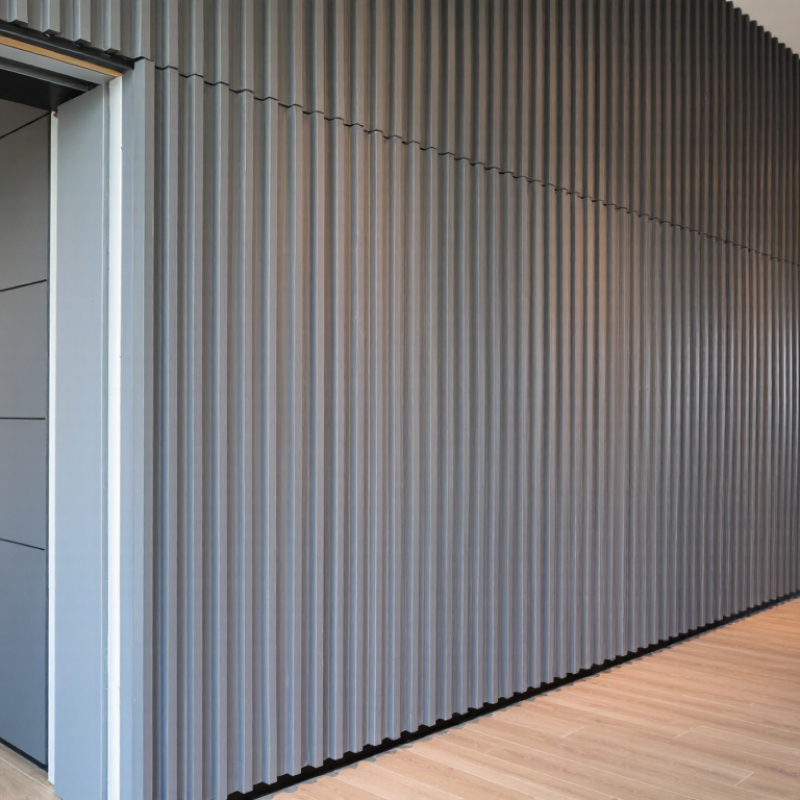
How to Choose the Best Fluted Wall Panels?

Define Project Needs: Room Use, Area, Budget, and Installation Conditions

Choosing the best fluted wall panels starts with the room, not the pattern. A living room may prioritize warmth and acoustic comfort. A bathroom demands moisture resistance, stable backing, and carefully sealed joints. For corridors, schools, and commercial spaces, impact resistance and cleanability matter more. Ask how the wall will be used every day.

Measure the area precisely, including doors, windows, outlets, and awkward corners. Add a small allowance for cutting waste. Large grooves can make a narrow room feel busier. Shallower profiles often work better in compact spaces. The 2024 Houzz & Home Study reported a median primary bathroom renovation spend of $13,500 in the United States. Treat this as a planning reference, not a panel budget. Labor, trims, adhesives, delivery, and substrate repairs can change the figure quickly.

Installation conditions deserve equal attention. Check wall flatness, moisture exposure, ventilation, and access for full-length panels. Uneven masonry may require battens or leveling work. That adds depth and labor. The U.S. Environmental Protection Agency notes that indoor pollutant levels can be two to five times higher than outdoor levels. Choose low-emission materials where occupants spend long hours. Also request fire-performance documentation, such as ASTM E84 or EN 13501-1 results, when regulations or project specifications require it. I have seen attractive installations fail because the substrate was ignored. The panel was blamed, unfairly.

How to Choose the Best Fluted Wall Panels?

Define project needs by evaluating room use, coverage area, budget, and installation conditions before selecting a panel solution.

The chart uses a practical 100-point planning model: room use and installation conditions receive the highest priority because they affect durability, safety, and installation feasibility. Area and budget then help determine the appropriate panel quantity, material, and specification.

Compare Fire Ratings: ASTM E84 Class A and EN 13501-1

How to Choose the Best Fluted Wall Panels?

Compare Fire Ratings: ASTM E84 Class A and EN 13501-1

Fire performance should be checked before appearance. Fluted wall panels can look identical but behave differently during a fire. ASTM E84 Class A measures surface flame spread and smoke development in a tunnel test. Class A generally means a flame spread index of 0–25. It does not prove fire resistance. It also does not rate every installation condition.

EN 13501-1 uses a different classification system. It commonly assigns reaction-to-fire classes from A1 to F. Smoke production and flaming droplets receive separate ratings. For example, B-s1,d0 indicates limited contribution to fire, low smoke production, and no flaming droplets. These results are not direct equivalents to ASTM Class A. Comparing them without technical context can create false confidence.

Check the complete test report. Ask whether the panel, core, surface finish, adhesive, and backing were tested together. Installation details matter. A panel fixed over a ventilated cavity may perform differently from one bonded to a solid wall. Request the exact classification for your project’s market and building type. Confirm the substrate and fixing method.

A neat comparison can mislead.

In my experience, sales sheets often show one attractive rating and omit the test limits. That omission deserves attention. Fire classification is only one selection factor, but it should never be treated as decoration. When evidence is incomplete, pause and request independent documentation from a qualified testing laboratory or fire consultant.

Evaluate Acoustics: NRC Ratings Tested Under ASTM C423

How to Choose the Best Fluted Wall Panels?

Evaluate acoustics before judging the groove pattern. ASTM C423 measures sound absorption in a reverberation room, using tested absorption coefficients at key frequencies. The Noise Reduction Coefficient, or NRC, averages results at 250, 500, 1000, and 2000 Hz, then rounds the value. A higher NRC generally indicates stronger broadband absorption. It does not guarantee better speech clarity in every room.

Ask for the complete ASTM C423 report, not a sales-sheet number. Check the tested panel size, backing material, air gap, mounting method, and laboratory details. These variables matter. A fluted panel installed over a 50-millimeter acoustic cavity may perform differently from the same panel fixed directly to drywall. ASTM E795 mounting guidance helps explain this difference. The uncomfortable part: an impressive NRC can still mislead when the installation changes.

Room targets should guide the purchase. ANSI/ASA S12.60 recommends classroom reverberation times of 0.6 seconds or less for rooms up to 10,000 cubic feet, with larger rooms allowing 0.7 seconds. The 2023 ASHRAE Handbook—HVAC Applications also treats reverberation control as a combination of absorption, room volume, and surface distribution. Place absorption near speech zones and reflective boundaries. Ceiling treatment may be necessary. More wall coverage is not always better. Review octave-band data, not only one rounded figure, because low-frequency performance often remains weak. Test the proposed assembly when the room is critical. Small details can change the result.

Check Durability: Moisture Resistance, Impact Strength, and Warranty Terms

How to Choose the Best Fluted Wall Panels?

Durability starts with moisture resistance, not appearance. The U.S. Environmental Protection Agency identifies persistent dampness as a major condition supporting indoor mold growth. Ask for independent water-absorption results, preferably tested under ASTM D570 or an equivalent method. A clear report should state exposure time, sample thickness, and percentage change. “Waterproof” alone proves very little. In bathrooms, inspect the panel edges, joints, and backing system. One weak seam can undermine an otherwise durable surface.

Impact strength matters in hallways, restaurants, and family rooms. Request an ASTM D5420 or equivalent impact report, including impact energy and visible damage after testing. A panel that survives one laboratory strike may still chip around cutouts. Review the installation instructions carefully. Substrate flatness, fastener spacing, and adhesive coverage can affect real performance. No panel is truly maintenance-free, and my first material choice would not always be the best choice after installation conditions change.

Tips: Compare the warranty with the test report. Look for coverage periods, moisture exclusions, fading limits, installation requirements, and replacement procedures. The 2023 National Association of Home Builders Cost of Doing Business Survey shows that warranty claims can materially affect construction costs, so vague language deserves attention. Keep product samples near a sink or entrance for several weeks. Check swelling, odor, surface marks, and joint movement. Small observations often reveal more than polished brochures.

Verify Panel Specs: Dimensions, Core Materials, VOC Limits, and Certifications

How to Choose the Best Fluted Wall Panels?

Before choosing a fluted wall panel, verify its actual dimensions. A listed size may describe the full sheet, not the visible surface. Measure the wall twice, then compare panel width, thickness, groove depth, and installation tolerance. Small differences can become obvious beside door frames or ceiling lines. Ask for a technical drawing, not only a product photograph.

The core material affects durability, weight, moisture resistance, and indoor air quality. MDF-based panels may provide a smooth finish, while polymer or mineral cores can perform better in damp areas. Do not assume that a heavier panel is stronger. Check density, water-resistance testing, fire performance, and recommended fixing methods. I once trusted a sample that looked rigid, but its thin backing flexed during installation. That mistake changed the final alignment.

VOC limits deserve careful attention. Request recent test reports showing the method, laboratory, sample condition, and measured results. “Low VOC” alone is not a useful specification. Certifications should also identify the issuing body, covered product, validity period, and applicable standard. A certificate for one finish may not cover every color or core. Requirements differ by project and region, so confirm them with the building professional or authority reviewing the work. Keep the documents with the purchase records. It makes later questions easier.

How to Choose the Best Fluted Wall Panels? - Verify Panel Specs: Dimensions, Core Materials, VOC Limits, and Certifications

Verification Dimension Typical Specification or Benchmark What to Check Before Purchase Why It Matters
Panel length and width Common decorative panel formats include approximately 2,400–3,000 mm in length and 300–600 mm in width. Actual sizes vary by construction and application. Confirm the exact finished dimensions, usable coverage, end-joint method, and dimensional tolerance stated on the technical data sheet. Accurate dimensions reduce cutting waste and help determine the number of panels required for the wall.
Panel thickness Decorative fluted panels are commonly about 12–25 mm thick, including the decorative face and structural backing where applicable. Verify whether the stated thickness includes the backing layer, felt layer, veneer, laminate, or surface coating. Thickness affects wall projection, trim alignment, screw or adhesive selection, and the finished appearance.
Flute profile and spacing Typical flute widths and center-to-center spacing range from approximately 20–40 mm, but profiles differ significantly between products. Request the flute width, depth, pitch, edge profile, and a cross-section drawing or physical sample. The profile determines visual scale, shadow lines, acoustic behavior, and how accurately adjacent panels align.
Dimensional tolerance A commonly stated manufacturing tolerance is approximately ±1–2 mm for panel dimensions, subject to the material and production method. Check the manufacturer’s written tolerance for length, width, thickness, straightness, and flute alignment. Tight tolerances produce cleaner seams and reduce visible variation across large installations.
MDF or HDF wood-fiber core Wood-fiber cores typically provide a smooth, machinable surface and stable support when kept within the recommended indoor moisture conditions. Confirm board density, moisture resistance classification, formaldehyde compliance, edge sealing, and whether the core is MDF, HDF, or particleboard. The core affects screw holding, weight, moisture sensitivity, machining quality, and long-term stability.
PET felt or polyester backing PET felt backings are commonly made from polyester fibers and may contain recycled content. Acoustic performance depends on thickness, density, and installation spacing. Verify recycled-content percentage, fiber density, fire classification, acoustic test method, and whether the backing is structural or decorative only. A felt layer can improve sound absorption, but it does not automatically make a panel fire-rated or suitable for every occupancy.
PVC or polymer core Polymer-based panels are generally resistant to moisture and are often selected for areas where wood-fiber products may swell. Check polymer type, temperature limits, fire test results, expansion allowance, odor information, and restricted-substance declarations. Moisture resistance does not eliminate the need to verify fire behavior, thermal movement, and indoor-air emissions.
Formaldehyde emissions from composite wood For applicable composite-wood products, commonly referenced U.S. limits include 0.05 ppm for hardwood plywood, 0.09 ppm for particleboard, 0.11 ppm for MDF, and 0.13 ppm for thin MDF under TSCA Title VI requirements. Request a current compliance statement, test report, or certification showing the applicable panel category and test method. Lower formaldehyde emissions support healthier indoor environments and may be required by building specifications.
VOC emissions For low-emitting building products, project specifications commonly reference CDPH Standard Method v1.2 or an equivalent chamber-testing protocol rather than relying only on an odor claim. Ask for a chamber-test report listing the tested product, conditioning period, individual VOC results, total VOC results, and applicable indoor-air category. VOC performance depends on the complete finished panel, including coatings, adhesives, laminates, and backing materials.
VOC test methods Common methods include ISO 16000-6 for VOC analysis and ASTM D5116 or related chamber procedures for emissions testing. Verify the laboratory, sample identification, test date, chamber conditions, and whether results apply to the exact finish and thickness being supplied. A test method and a numerical result are more reliable than an unsupported “non-toxic” or “zero-VOC” statement.
Indoor-air certification Recognized low-emitting product certifications may evaluate VOC emissions, formaldehyde, and other indoor-air requirements using defined procedures. Confirm that the certificate is current, covers the exact product construction, and identifies the approved finish, color, backing, and adhesive if applicable. Certificates can simplify project review, but only when the certified configuration matches the material being installed.
FSC or recycled-content documentation FSC documentation applies to eligible responsibly sourced wood fibers or wood products. Recycled-content claims should state the percentage and calculation basis. Request a chain-of-custody certificate for wood claims or a verified recycled-content declaration for PET and other recycled materials. Sourcing and recycled-content claims are material-specific and should not be assumed from a general sustainability statement.
Fire performance Fire classification depends on the complete assembly, including the panel, surface finish, backing, substrate, air gap, and installation method. Request the applicable fire-test report and verify the tested thickness, mounting method, substrate, and classification required by the project. A material described as fire-resistant is not automatically compliant with a specific building-code requirement.
Moisture and installation suitability Wood-fiber panels are generally intended for controlled interior conditions, while polymer panels may tolerate higher humidity but still require movement allowances. Check the approved humidity range, acclimatization instructions, expansion gaps, wall-flatness requirement, and compatible adhesive or mechanical fasteners. Correct installation protects against bowing, swelling, joint opening, adhesive failure, and surface distortion.
Documentation quality A reliable technical package should include a data sheet, installation guide, safety information, test reports, certificates, and product revision date. Match every document to the exact product code, core, finish, thickness, and production batch where available. Traceable documentation makes technical comparison and compliance verification more dependable.

Note: Dimensions and material ranges are common market benchmarks, not universal requirements. Always verify the exact product configuration, test reports, installation conditions, and local building-code requirements before specification.

FAQS

What does an ASTM E84 Class A rating indicate?

It generally indicates a flame spread index between 0 and 25. It also considers smoke development. It does not prove fire resistance. Test conditions matter.

Is ASTM E84 Class A equivalent to an EN 13501-1 rating?

No. These systems measure fire behavior differently. EN 13501-1 uses classes from A1 to F. Smoke and flaming droplets receive separate ratings. Direct comparisons can create false confidence.

What does a classification such as B-s1,d0 communicate?

It suggests limited fire contribution, low smoke production, and no flaming droplets. Always review the complete classification. One label is not enough.

Should the panel and its installation system be tested together?

Yes, whenever possible. The report should identify the panel, core, finish, adhesive, backing, and substrate. A ventilated cavity may perform differently from a solid wall. Installation changes results.

What documents should be requested before choosing fluted wall panels?

Request the complete test report, classification limits, and installation instructions. Confirm the project market and building type. Check the fixing method and substrate requirements. Incomplete evidence deserves caution.

How can moisture resistance be evaluated?

Request independent water-absorption data. The report should state exposure time, sample thickness, and percentage change. “Waterproof” alone proves very little. Inspect edges, joints, and backing near sinks or showers.

Why does impact strength matter?

Impact performance matters in hallways, restaurants, and family rooms. Ask for impact energy and visible-damage results. Cutouts may chip even when a flat sample survives. Laboratory success is not everything.

What should a wall-panel warranty include?

Check coverage duration, moisture exclusions, fading limits, installation conditions, and replacement procedures. Compare the warranty with the test report. Vague wording deserves attention. Read the small details.

Can a panel be considered maintenance-free?

No panel is completely maintenance-free. Keep a sample near an entrance or sink for several weeks. Check swelling, odor, surface marks, and joint movement. My first choice might change after real installation conditions appear.

Conclusion

Choosing the best Fluted Wall panels begins with clearly defining your project needs. Consider the room’s purpose, the total installation area, your budget, and site conditions such as wall type, humidity, ventilation, and access for installation. Safety should be a priority, so compare fire-performance ratings, including ASTM E84 Class A and EN 13501-1 classifications, to determine whether the panels meet the requirements of your building and application.

Acoustic performance is also important, especially in offices, hospitality spaces, studios, and shared areas. Review NRC values tested under ASTM C423 rather than relying only on general claims. In addition, evaluate moisture resistance, impact strength, cleaning needs, and warranty coverage to ensure long-term durability. Before purchasing, verify panel dimensions, core materials, VOC limits, installation details, and relevant certifications. A careful comparison of these factors will help you select panels that balance appearance, safety, comfort, performance, and overall value.


Oliver

Oliver

Oliver is a seasoned marketing professional with a wealth of expertise in driving brand awareness and engagement. With a deep understanding of our company's product offerings, he consistently delivers high-quality content that enriches our professional blog. His insights not only shed light on......